The Neurology & Neurosurgery department at MVA is here to provide the answers and advanced care your family deserves. Our team uses unparalleled expertise and state-of-the-art technology to diagnose and treat conditions of the nervous system, helping your pet get back to being themselves.
What is a Veterinary Neurologist?
A board-certified veterinary neurologist is a specialist who has completed years of advanced residency training after veterinary school, focusing exclusively on the complex nervous system, which controls your pet’s body: the brain, the spinal cord, and the peripheral nerves.
Our pets can suffer a wide array of neurological and neuromuscular disorders that are treatable with the expertise of a veterinary neurologist. Some of these problems may manifest themselves as seizures, limb paralysis, weakness, balance disorders, vision disorders, and pain. Animals experience many of the same brain, spinal cord, nerve, and muscle problems that humans face, including epilepsy, concussions, spinal cord injuries resulting from slipped discs or spinal fractures, and tumors.
When Does Your Dog or Cat Need to See a Neurologist?
Your primary veterinarian may refer you to MVA’s neurology department if your pet shows any of the following signs. These symptoms are always a reason for a prompt veterinary visit:
Seizures
Any episode, from a “grand mal” (collapsing, shaking) to a “focal” seizure (facial twitching, “fly-biting,” zoning out).
Balance Problems
A new head tilt, stumbling, walking like they are “drunk” (ataxia), or falling over.
Spinal Pain
Yelping when petted on the neck or back, a “hunched” posture, or unwillingness to turn their head.
Weakness/Paralysis
Dragging the back legs, “knuckling” their paws (walking on the top of the foot), or a sudden inability to stand or walk.
Behavioral Changes
Sudden confusion, disorientation, getting “stuck” in corners, or circling in one direction.
Loss of Vision
Sudden blindness that is not related to the eyes themselves.
Tremors
Uncontrolled shaking of a muscle or the entire body.
Advanced Diagnostics: Finding the Answer
The nervous system is delicate and complex. To find the source of a problem, we must be able to “see” it.
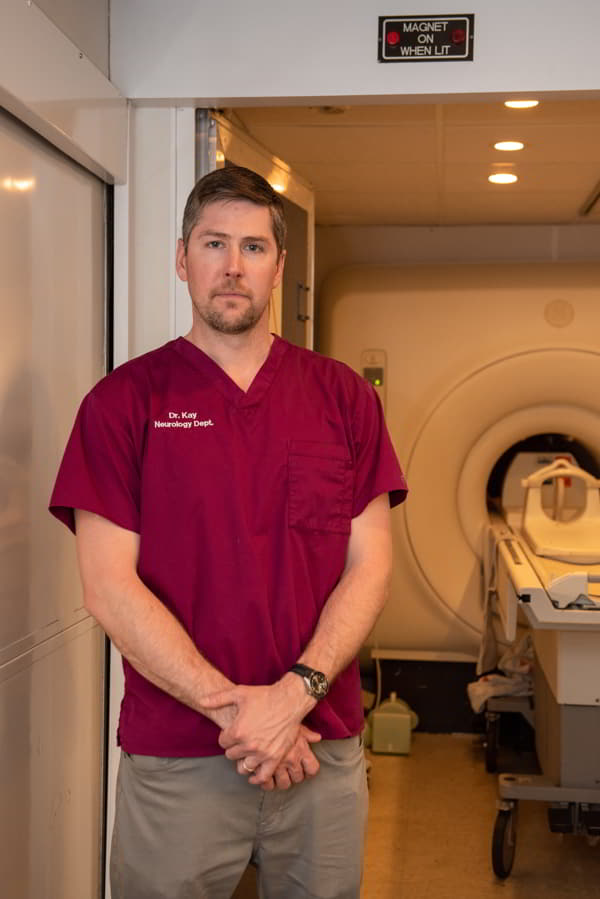
In addition to performing neurological examinations, neurologists utilize advanced diagnostic techniques using Myelography, Computed tomography (CT), Magnetic Resonance Imaging (MRI), Cerebrospinal fluid (CSF) sampling and analysis, muscle and nerve biopsy, and electric nerve impulse tests to diagnose conditions. These procedures can identify the problem and guide the neurologist towards an appropriate treatment plan for your pet.
Once we have a diagnosis, our team will create a comprehensive treatment plan tailored to your pet. We are proud to offer both advanced medical and surgical solutions.
Your Partner in Care
Our neurology department works as a team with you, your primary care veterinarian, and MVA’s other specialists—like oncology, radiology, and critical care—to ensure your pet receives seamless, world-class care from diagnosis to recovery.
Daniella Vansteenkiste
BVetMed, MS, DACVIM (Neurology)
MVA

Melissa Logan
PhD, DVM, DACVIM (Neurology)
MVA

William Kay, Jr.
VMD, DACVIM (Neurology)
HVSH
If you are concerned about your pet’s neurological health, please talk to your primary veterinarian about a referral to one of our specialty neurology departments at either Metropolitan Veterinary Associates or Hickory Veterinary and Specialty Hospital.